




AI in software development – between euphoria and reality
ChatGPT is omnipresent in both private and business life. Large language models, too, have long been a reality in software development. The promises are seductive: drastic increases in efficiency, automated tasks, perhaps even opening up software development to a wider audience. However, there is a considerable gap between the announcements of the tech giants and actual fitness for purpose in an enterprise context. Three narratives dominate the debate – and all three deserve a differentiated consideration.
1. Increased efficiency: the promise of magic percentages
“30 percent faster development”, “50 percent more productivity”, “double the output capacity” – the promises come thick and fast. Studies by tool providers suggest leaps in productivity that are rarely achieved in practice. There are indeed areas in which AI tools enable significant efficiency gains: the generation of boilerplate code, the creation of unit tests, documentation, or refactoring according to known patterns. This is where AI delivers real added value. The problem comes when speed is considered in isolation. Software development is not a sprint, but a marathon. Code that is generated in record time today can become a technical liability tomorrow if it lacks quality. Maintainability, expandability, security, and performance cannot be replaced by speed. Low-quality code churned out at speed becomes a boomerang, and the initial efficiency gains are negated by expensive redrafting. So the goal cannot be to produce more code in less time. The aim is to develop higher quality software with the same resources - more robust, safer, more maintainable. Or vice versa: achieving the same level of quality with less effort. Measurability remains a key challenge. Which KPIs are useful? How can you quantify an increase in efficiency? It often helps to be pragmatic: direct feedback from the development teams, supplemented by objective metrics such as test coverage, the scope of documentation, or the bug rate over time. Something that is often underestimated is that the adoption curve is flat. Developers need time to integrate AI tools into their workflow effectively. In the enterprise environment, it realistically takes six to twelve months before measurable efficiency gains can be seen. This ramp-up phase must be factored in.
2. No-code utopia: Will we soon not need any more software engineers?
Tools such as Bolt.new or Lovable have coined a new category: what is known as “vibe coding”. You describe in natural language what the software should do, and the AI generates the implementation. The code becomes a commodity, a black box that nobody now needs to understand. This works surprisingly well for prototyping ideas. The barrier to entry is lowered, non-experts can experiment, and concepts become tangible. This approach is justified and adds value. As soon as the focus is on software for business use, however, the no-code fairytale comes to an abrupt end. Production systems that map business-critical processes, process sensitive data, and have to remain maintainable for years have completely different requirements. The generated code must be checked, understood, and evaluated: Is the architecture consistent? Are the patterns clean? Has adequate consideration been given to security? What about logging, monitoring, and error handling? These questions can only be answered by those with an in-depth technical understanding. Paradoxically, it is senior software engineers who benefit most from AI tools. They have the experience to evaluate AI-generated code critically, identify weaknesses, and correct them selectively. Junior engineers or non-experts, on the other hand, lack this foundation. The idea that AI can independently develop complex enterprise systems in production-ready quality is unrealistic today – and will probably remain so in the coming years. Software engineering remains the domain of experts. AI is changing the tools, not the need for expertise.
3. AI as a panacea: The search for answers to the “AI First” problem has become something of a mantra.
Companies are defining AI strategies, launching initiatives, and setting themselves ambitious goals. The problem is that the majority of these projects fail. Not because of the technology, but because of the mindset. AI is often seen as a predetermined solution in search of a problem. The result is generic corporate chatbots with minimal added value. AI projects for the sake of AI. The correct perspective is to treat AI as a tool – powerful and versatile, yes, but still a tool. The question should not be: “Where can we use AI?”, but rather: “Which tool is the best one for this specific problem?”
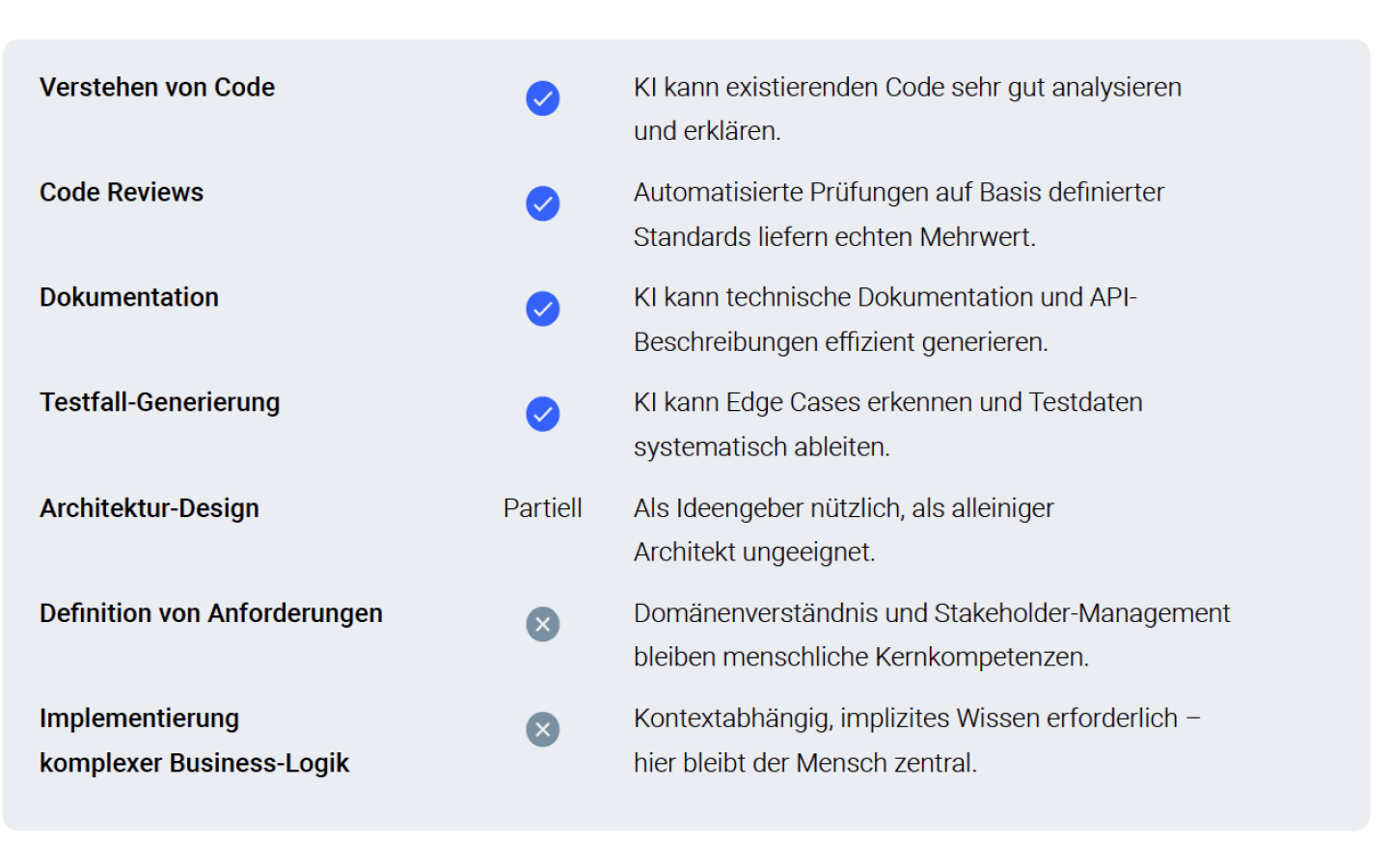
Which Enterprise Software Engineering tasks are really suitable for AI support, and why?
The bottom line: realism rather than euphoria
Generative AI is not a fad. Technology is changing software development permanently, accelerating processes, and opening up new possibilities. The potential is real and considerable. At the same time, it is important to separate the hype from the reality. AI will not replace software engineers, but it will transform their work. The most valuable developers of the future will be those who can use AI tools with confidence. Because they understand when, how, and where it makes sense to use them. Successful AI adoption in an enterprise context requires patience, a desire to experiment, and realistic expectations. Efficiency gains take time. Quality remains non-negotiable. AI is developing at a pace that can overtake even expert knowledge within a matter of months. Those who continue to educate themselves and keep asking questions will remain relevant.
ti&m Special “AI & Open Source”
Why AI and open source belong together
Special, Future of Work
Working in the cloud – the challenges for data protection
Data protection // Sooner or later, every organization or business needs to address the question of digital transformation and therefore get to grips with the cloud. A number of aspects must be carefully considered first in order to avoid any legal pitfalls.
Ursula Sury - Oct 24, 2022
AI-and-Open-Source, Special
Digitalization of social insurance requires a federal approach
Dominik Blunschy - Mar 10, 2026