




How open source can strengthen digital sovereignty
Digital sovereignty // It is becoming increasingly vital that businesses, public administrations, and society view technological adaptations in the context of digital sovereignty. With the ti&m Open Source Stack, we are helping companies and institutions maintain sovereign control of their data, processes, and applications in the long term.
Technology, today primarily AI, is radically changing business models, production processes, and customer service. At the same time, though, dependence on global technology providers is growing. Anyone using software, data, or AI models today is to some extent relinquishing control over their critical business and customer data. This results in dependence on proprietary platforms, lock-ins, limited flexibility, potential security and compliance risks, and ever-increasing costs with no alternative. For Switzerland, therefore, a country committed to and stability, digital sovereignty is not an option – it is a strategic imperative. Digital sovereignty encompasses far more than just issues relating to the storage and use of data, however: Businesses and administrations need to think carefully about which technologies and services they purchase from which providers.
ti&m Open Source Stack: software, hosting, and support
With the ti&m Open Source Stack, we are helping businesses gradually move away from proprietary technologies, or at least establish alternatives. The stack includes selected open-source components from leading providers, secure operation in our Swiss private cloud, and hybrid or on-prem 24/7 support. Continuous enhancements in policy-as-code, MLOps, and FinOps enable our customers to remain technologically future-proof and economically transparent. All components are auditable, and openly visible. Active further development by the open-source community ensures a high speed of innovation, while ti&m takes care of maintenance, updates, and quality assurance. We provide support for the entire operation, from faults and software bugs to complex queries. Our comprehensive monitoring tools detect problems proactively, and our service desk acts as a central point of contact. Tiered service level agreements (SLAs), DevOps infrastructure, and software management ensure stable, secure, and scalable operation. They also cover the entire application lifecycle management process.
The ti&m Open Source Stack gives our customers maximum control and legal certainty, cost efficiency, and full transparency, minimized risks, and a real head start in innovation thanks to a short time-to-market and a sovereign technology foundation.
LLMs: open source and vertical
One of the most important decisions when setting up AI solutions is choosing suitable language models. We constantly test the suitability of LLMs before integrating them into our stack and providing them to our customers as an alternative. For the open source we are currently using Mistral and now also Apertus, a completely open LLM developed by EPFL, ETH Zurich and the Swiss National Supercomputing Center (CSCS). Apertus’ architecture, model weights, training data, and training methods are published transparently and can be used freely – an excellent example of how open source and Swiss AI innovation work together. At the same time, we are seeing increasing specialization in large language models: More and more vertical LLMs coming onto the market are geared towards a specific area of application or sector. With domainspecific knowledge – such as in banking, law, or medicine – they deliver more precise, reliable, contextsensitive results. For our industryspecific AI solutions, we use these specialized models to signifi cantly increase the quality and relevance of the results. This results in scalable, practical applications that enable businesses and administrations to use AI sovereignly and sustainably. We are also constantly adding new AI features to our products. At the moment we are integrating the “AI Banking Assistant”, an AIassisted banking experience, into our “ti&m Banking” mobile and ebanking platform. AI is not only the driver of many customer solutions, but also an integral part of software development at ti&m, from architecture to coding to quality assurance. Our “AIpowered innovation” strategy is helping us increase efficiency in local development projects while keeping costs low.
Data platform and reusable software modules: completely open source
At ti&m, this opensource mindset generates solutions such as our Open Datastack data platform or the Solution Building Blocks. Open Datastack, our opensource componentbased data platform, can be operated in the cloud or onpremises. Focused on collaborative analysis, dashboards, and workflows, it enables businesses and administrations to use data interactively, securely, and effi ciently, create transparency, and make datadriven decisions. Meanwhile, our Solution Building Blocks (SolBB), give public administrations a triedandtested, modular, and opensourcebased software and methodology platform. The blocks include modules for backend, frontend, processes, master data, and security. They also accelerate the implementation of digital solutions for residents, e.g. applications and permits. Reusable components, proven architectural principles, and regulatory compliance with EMBAG (Federal Law on the Use of Electronic Means for the Fulfi llment of Governmental Tasks) ensure efficient, secure, and sustainably operated applications without any vendor lockin. With every project, we are also strengthening the open-source community at the same time.
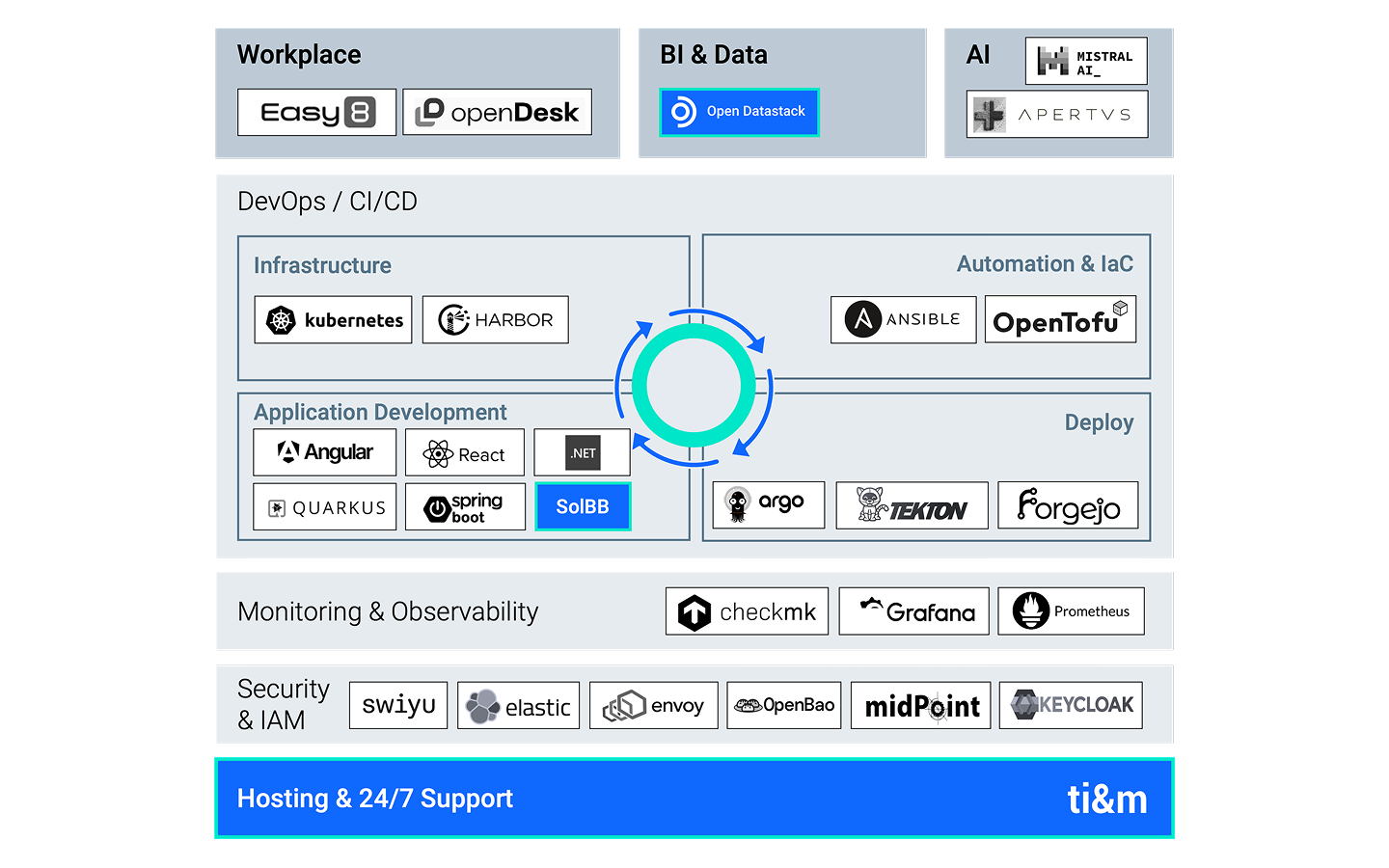 ti&m Open Source Stack: Our tested application selection
Why it is crucial to take action today
Digital sovereignty is not a state, but an ongoing process. Organizations that currently rely on transparent, open, and locally anchored solutions will gain flexibility, security, and the ability to innovate in the long term. AI is the lever – but only if it is used in a sovereign, comprehensible, and controlled manner. ti&m supports businesses and public authorities along this path. We combine technological openness, Swiss engineering, compliance, and AI expertise in a holistic approach. This creates a stable, futureproof framework in which innovations are possible without creating dependency – and in which digital sovereignty and artificial intelligence go hand in hand.
ti&m Special “AI & Open Source”
Why AI and open source belong together
Special, Future of Work
Get close to your customers online too
Online customer advice // Digital channels for customer advice are gaining traction. This has been thrown into sharp relief by the pandemic-related restrictions on contact. The challenge: The personal touch can be hard to convey on digital channels. The solution? Offer customers one-on-one advice online.
Stefan Lüthy - Oct 3, 2022
Special, AI
Cyber risk mitigation — increasing costs or creating value?
Cybersecurity // Protecting critical data, systems and processes affects core elements of a company’s value creation chain, and is directly linked to the firm’s success. Company management teams must manage these cyber risks and be proactive in staying aware of the associated responsibilities.
- Mar 20, 2024
AI-and-Open-Source, Special
“If you opt for on-prem technology, you assume full responsibility for security”
Guardrails, prompt injection, and the AI Banking Assistant: Joel Akeret, Machine Learning Architect at ti&m, talks about the risks of AI in banking and why relying on a single security filter is not as safe as it may seem.
Joel Akeret - Jun 15, 2026