




How companies can reduce dependencies while remaining economically viable
Digital sovereignty is no longer just an ideological debate. For businesses and government agencies, it has become a purely economic issue: How can we reduce technological dependencies, manage risks, and save costs in the long term? The key point here is not whether an organization is fully sovereign. The key question is where digital sovereignty becomes critical to business operations, and where dependencies can be consciously accepted. Today, we need to make these decisions based on risk, benefits, and costs.
Sovereign alternatives are becoming commercially viable
The situation has improved. Just a few years ago, sovereign alternatives to established platforms were often limited in functionality or hard to integrate. Today, there is a more robust ecosystem of open-source technologies and European and Swiss providers in key areas such as cloud computing, identity management, collaboration, security, data platforms, and AI.
OpenDesk, for example, is a proven open-source alternative to Microsoft 365. European providers are investing specifically in cloud, data, and AI infrastructures that prioritize data protection, regulatory compliance, and regional value creation. The market is evolving, and with it, the opportunities for companies to actively manage their digital dependence.
Balancing innovation speed and control
But digital sovereignty is still a contentious issue. Hyperscalers continue to offer clear advantages in terms of globally scalable infrastructure, specialized AI services, and highly standardized platform services. In many cases, completely forgoing these would be neither realistic nor economically sound. In fact, successful strategies rely on hybrid models: Leveraging global platforms where scalability and the speed of innovation are critical, and utilizing open-source, European, or Swiss solutions where control, compliance, and strategic independence are paramount.
Transparency as a foundation for informed decisions
Transparency is key here. While many companies today are aware that dependencies exist, they often do not realize how deep these run, what risks they pose, or what economically viable alternatives are available. That is precisely why digital sovereignty requires a structured and measurable approach. With the ti&m Digital Sovereignty Check, we provide this transparency. The check systematically analyzes dependencies, evaluates risks, and quantifies the level of digital sovereignty across dimensions such as control and autonomy, portability and interoperability, regulatory requirements, and cost-effectiveness.
The goal is not maximum independence at any cost, but rather a sound basis for decision-making: Where do real risks arise? Where is it worth having more control? And where do the effort and costs outweigh the actual benefits?
Why investment is on the rise
Willingness to invest is really growing, particularly in the public sector, regulated industries, and safety-critical organizations. The drivers are geopolitical uncertainties, regulatory requirements, and growing sensitivity to technological lock-in effects. At the same time, there is a stronger focus on the cost structures of proprietary oligopolies. Many organizations are finding that a lack of alternatives is creating not only strategic risks but also significant financial risks in the long term.
Open source is becoming a strategic pillar
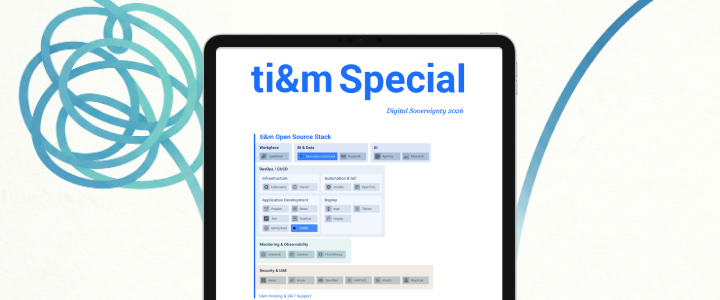
At the same time, building self-sufficient IT environments is becoming more and more feasible from an operational standpoint. With the ti&m Open Source Stack, we provide field-proven building blocks for key IT areas such as Workplace, Data & Analytics, Security, and AI. Today, open-source technologies enable powerful, flexible, and auditable platforms that can be operated in hybrid environments, entirely on-premises, or in a Swiss private cloud. This is not just about technology, but the entire lifecycle: from architecture and integration to operation, maintenance, and enterprise support.
Unlocking data and AI without lock-in
This shift is particularly evident in the data and AI sectors. Our AIdriven business intelligence platform, Open Datastack, is a prime example of how modern data infrastructures can be built without proprietary lock-ins. This gives companies the opportunity to develop their data platforms in a modular, open, and sustainable way – in the cloud or on-premises. In turn, they benefit from the opensource community’s rapid pace of innovation while still being in control of data, costs, and future development.
Pragmatism is key to sovereignty
Our project experience has shown us that digital sovereignty only works when approached with pragmatism. Not every system needs to be completely independent. Not every proprietary solution is automatically problematic. What is crucial, rather, is clear governance with well-defi ned responsibilities, granular access models, encryption, and deliberate architectural decisions.
Turning sovereignty from a buzzword into an infrastructure strategy
At the same time, we are seeing encouraging momentum in the market. The discussion surrounding digital sovereignty is getting more and more tangible and actionable. Projects such as the development of a Swiss government cloud, the introduction of e-ID, and numerous European open-source and cloud initiatives demonstrate that people are starting to see digital sovereignty as a strategic infrastructure priority – both economically and socially.
ti&m Special “Digital Sovereignty”