





Zurich, 07.10.2026
Digital Sovereignty Study: Costs are rising, but hardly any companies are reacting
Although digital sovereignty is a high priority for Swiss companies, it is rarely enshrined as a binding requirement. Across all industries, 73 percent of the 200 organizations surveyed see this topic as very or somewhat important. However, only 35.6 percent of them have developed a strategy for digital sovereignty, and only 32.2 percent have exit strategies for at least some critical services.
The key findings
- A significant 73 percent of respondents see digital sovereignty as important, but only around a third have a strategy or exit plans in place.
- Data sovereignty shapes organizations’ understanding of this issue. Cost stability is the least relevant objective, even though price increases are the most common type of damage actually incurred.
- Workspace solutions are the biggest dependency at 71.5 percent, and the biggest price driver at 50.5 percent.
- Despite its short market presence, AI is already the fourth-largest driver of dependencies and costs.
- Around 70 percent expect investment in digital sovereignty to stagnate or decline, while 43.5 percent anticipate growing dependencies.
Dependency is estimated, not measured
Most respondents rate their dependency on large IT providers as somewhat high or very high. Only around half have systematically assessed it. This means that, in many organizations, dependency is a plausible assumption rather than a proven finding. The mitigating measures implemented are correspondingly weak: Only a fraction of the companies with a high level of dependency undertake regular provider audits or have documented exit options.
It is worth noting that the occurrence of incidents makes little difference here. Companies that have already had negative experiences are not much better positioned in terms of strategy, roles, and exit plans than those where no such incidents have occurred.
The biggest perceived risk rarely occurs
Loss of control of sensitive data tops the risk list; preventing this is the main aim of efforts to ensure sovereignty. Actual incidents of this kind are rare. It is much more common for providers to unilaterally dictate large price increases that companies cannot challenge due to a high level of dependency. Digital sovereignty is thus primarily treated as a data protection and regulatory issue, whereas in practice it mainly impacts on costs.
“Most companies know they are dependent. However, only half of them assess this systematically. Any organization that does not measure its dependencies can’t quantify the risk or decide where investment is worthwhile.”
Thomas Wüst, CEO of ti&m
An opaque topic, especially on the financial side
Across all questions, “Don’t know” accounts for around 15 percent of responses. When it comes to financial issues such as cost increases, investments, and budgets, this figure rises to 30–45 percent, indicating that the economic consequences of dependencies are not quantified in many organizations. Without numbers, there is no business case: Only 13 percent of respondents expect greater digital sovereignty to reduce costs.
Open source remains a niche topic
For most respondents, open source plays a minor role in procurement and architecture. Yet the study shows that organizations that actively consider open source as a criterion report fewer dependencies across all dimensions and achieve a higher index score.
Four archetypes, four priorities
The Digital Sovereignty Index assesses companies based on their strategy and governance as well as actual implementation. This results in four archetypes: sovereignty leaders, planners, implementers, and followers. A considerable 58 percent of participants are poorly prepared or have mainly focused on strategic planning thus far. The full index system and the recommendations for each archetype are presented in the study.
Recommended steps: How to go from assumptions to measurement
- Create transparency: Assess the vision, existing governance artifacts, and budgets before defining measures
- Develop and test exit capabilities for critical services rather than just documenting them
- Embed governance structures and knowledge: Digital sovereignty is an ongoing task, not a project
- Incorporate open source into architecture and procurement management and evaluate it when making new purchases
- Address AI dependencies at an early stage: Explore sovereign AI alternatives and ensure technical flexibility when selecting providers
How ti&m assists companies
ti&m supports organizations from assessing their as-is situation through to operation.
Gain transparency on dependencies and costs: Analyze the risks and costs of your IT landscape with the ti&m Digital Sovereignty Check, which includes an evaluation and prioritized measures.
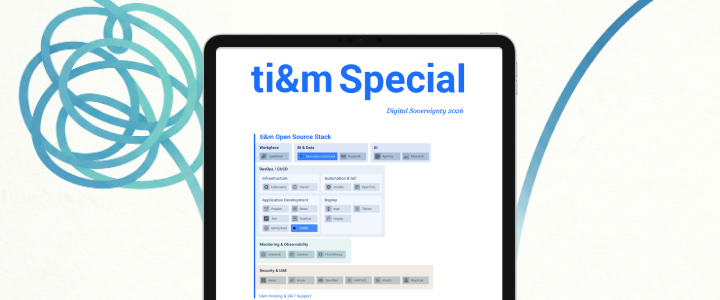
Evaluate alternatives: The ti&m Open Source Stack consists of proven, ti&m-operated open-source solutions for security and IAM, DevOps, workplace, data, and AI. Open Datastack provides a sovereign, open-source-based data platform.
Draw up a vision and embed governance: Road map, recommendations, and governance fundamentals, with roles, architectural principles, and exit strategies.
Support with migration and operation: ti&m migrates your existing applications to open-source solutions and operates them on your infrastructure or in ti&m’s Swiss private cloud.
About the study
The Digital Sovereignty Study 2026 was conducted jointly by ti&m and the Lucerne University of Applied Sciences and Arts. In total, 200 participants from more than 15 sectors responded to the survey. The study assesses the as-is situation in organizations across four dimensions: strategy and governance, data sovereignty, technological sovereignty, and operational sovereignty.
***
About ti&m
ti&m stands for technology, innovation and management.
We are the Swiss leader in digitalization projects and products. With AI-powered innovation and a strong commitment to open source, we efficiently address our clients’ challenges and provide vertical integration along the entire IT value chain.
Across our offices in Zurich, Bern, Basel, Frankfurt am Main, Dusseldorf, and Singapore, we employ over 550 highly skilled engineers, designers, and consultants. As we open new locations, we continue to bring our expertise to additional financial and technology hubs, aligned with our clients’ evolving needs.
Contact
If you have any questions, the marketing team will be happy to assist you. marketing@ti8m.ch, Tel. 044 497 75 00