




No more “Works on my Machine”: MLOps “Golden Path” blueprint for regulated industries
We are now in 2026. The days when data science teams handed their models over to the IT department on a USB stick or as a ZIP file are finally over. The tooling landscape has undergone huge consolidation in recent years. Today, we’re no longer discussing whether we need containers, but how we can secure the supply chain of our AI models so that they not only perform well, but also meet the rising governance requirements.
Nevertheless, we often see a paradox in our projects at ti&m: While algorithms are becoming increasingly complex (transformers, agentic workflows), the engineering is lagging behind. Notebooks are “hacked” in production, or pipelines - so fragile that nobody dares touch the requirements.txt - are built.
For companies that see ML not as a playground, but as a business-critical driver, there’s only one solution: platform engineering. We need to build a “Golden Path” – a standardized, highly automated road to production.
In this article, we show what a blueprint such as the one we’re currently designing for customers in regulated industries (banks, insurance companies) might look like. We look under the hood of GitOps, OCI artefacts, modern dependency management with uv, and observability.
The mindset: Compliance by design and Swiss pragmatism
Before we look at the code, a word about the architecture. In a regulated environment, “agility” is not a license for chaos.
The issue of regulation – think EU AI Act – is also of central importance for Swiss companies. Although we’re politically independent, our economies are heavily intertwined. As soon as a Swiss company offers AI services in the EU, extraterritorial regulations apply. Swiss legislators are also guided by international standards.
For us technicians, the crucial factor is not so much the legal text, but the technical implications. Two aspects in particular are relevant for MLOps platforms:
Technical documentation & record keeping (Art. 11 & 12): We must be able to provide complete proof of how a model was created. Who trained it? On what data? With which parameters?
Accuracy, robustness & cybersecurity (Art. 15): A model must be non-manipulable and protected against attacks.
Manual steps are the enemy here, so our goal at ti&m is to build a platform where compliance is the automatic result, not a form that you fill out at the end.
Our architecture principles for 2026:
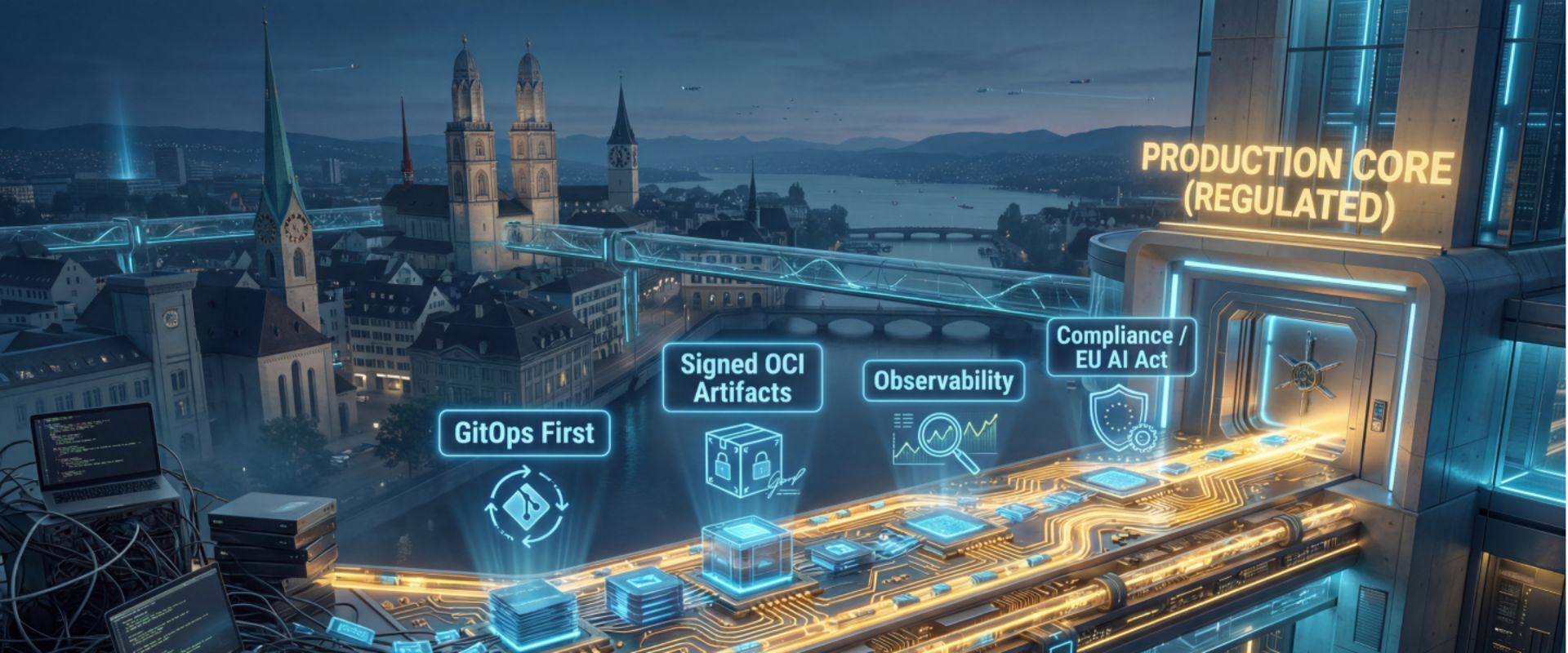
1. GitOps first: The single source of truth is always Git. This guarantees a complete history (audit trail).
2. Immutable artifacts: A model is a binary artifact built once and then promoted unchanged through the stages (Dev, Test, Prod).
3. Separation of concerns: Data scientists provide the content (code + parameters), the platform provides the framework (security, scaling, monitoring).
Deep Dive 1: Reproducibility begins locally (the uv revolution)
Let’s take a brief look back. Dependency management in Python has long been a nightmare. pip, poetry, conda, pipenv – it often took minutes to resolve dependencies.
In 2025, uv established itself as the de facto standard and, in 2026, is indispensable in modern stacks. Why is this crucial for MLOps? Because governance stands and falls with reproducibility.
When a data scientist develops a model locally, the environment must correspond bit for bit to the training environment in the cloud. In the past, “Works on my Machine” led to hours of troubleshooting in the CI pipeline.
With uv, we can create and synchronize environments in milliseconds.
How this looks in practice:
Instead of a loose requirements.txt, we use strict lock files (uv.lock) that work across platforms.

Special, AI
The future of blockchain interoperability
Web 3.0 // Blockchains play a key role in the ongoing development and decentralization of the internet. With “the interchain”, the Interchain Foundation in Zug is establishing an ecosystem that simplifies interoperability between individual chains through standards, thus driving the development of Web 3.0.
Mary McGilvary - Apr 1, 2024

Technology, Business
Ab in die Cloud – wie ti&m Helsana+ in die Cloud brachte
Daniel Killen - Mar 23, 2020