




Data Fusion and AI Banking Assistant: new possibilities in banking
The financial sector is currently experiencing a phase of rapid technological development. In the end-customer business, modern mobile experiences, personalized recommendations, and AI-supported analyses are shaping the customer experience. In the coming years, functions such as multi-banking and personal financial management, as well as solutions in the area of digital assets, will establish themselves as standard. In B2B, automated credit processes, support for external asset managers, and robo elements are accelerating the digitalization of entire business models. At the same time, banks are keeping a close eye on the development of stablecoins and other new infrastructures – and expect platforms that react flexibly to such developments. ti&m Banking is one of the most modern and open mobile and e-banking platforms in Switzerland and is in use at around 30 banks. Together with ti&m Banking Integration, our integration solution for core banking systems, we offer banks a stable foundation for modern digital banking and create the basis for bringing innovations to market quickly, securely, and modularly. Our banking products remain open to new technologies, such as the addition of Data Fusion and the AI Banking Assistant.
Data Fusion: using core banking data with minimal effort
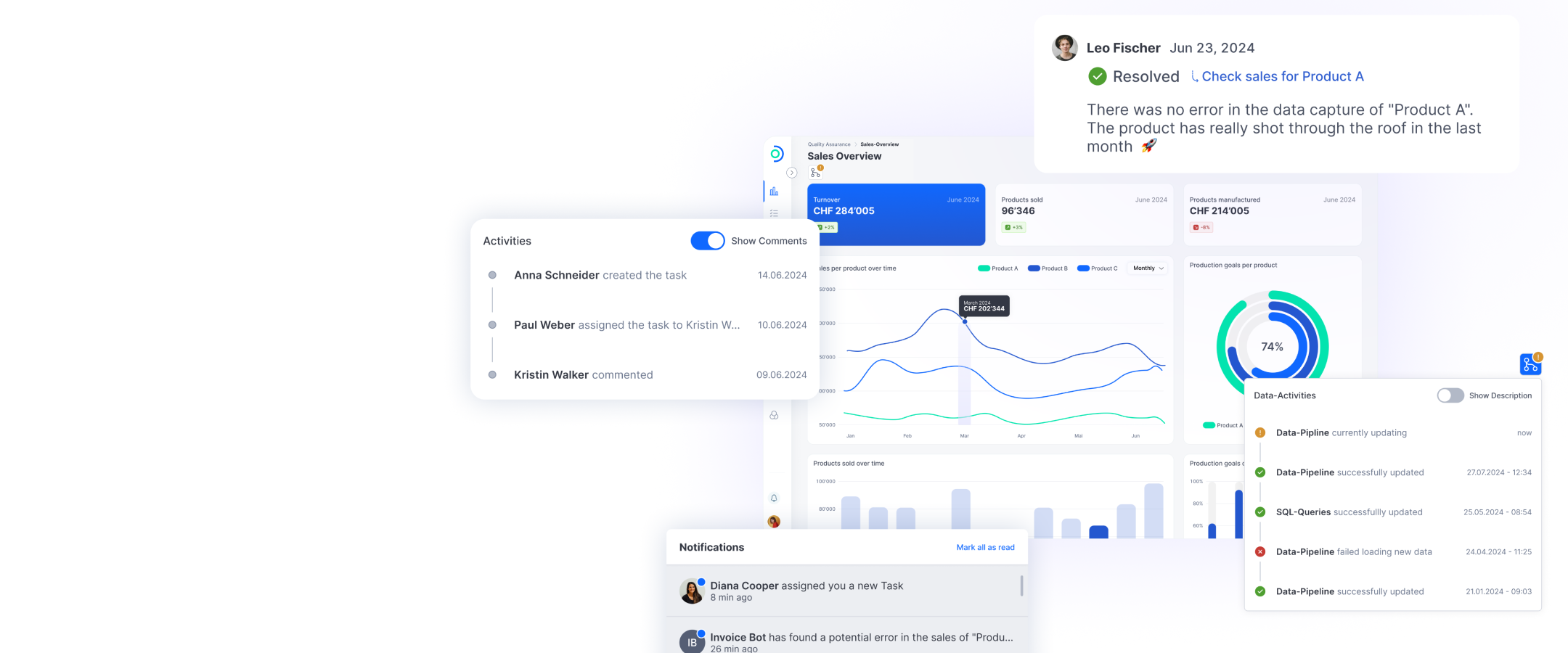
Banks have valuable data in their core banking systems, but accessing it is often complex, expensive, and embedded in lengthy integration projects. This means that many projects are not implemented because the costs do not justify the expected added value. Innovative ideas and approaches that could lead to solutions with added value are not even considered. This is where Data Fusion comes in. It is a no-code solution that provides data from core systems in a flexibly configurable manner via interfaces. Third-party applications such as compliance or CRM systems can use this data directly to implement new business cases, without spending a lot of time and effort on integration.
The principle of Data Fusion
Data Fusion receives data from the core banking system via integration messages and makes it available to applications via Open API interfaces. No programming is required to configure the solution. Instead of creating a new point-to-point integration for each project, business departments or IT teams define which data an application requires. Data Fusion then automatically generates the appropriate APIs. The result? A flexible, domain- oriented data architecture that consistently supplies peripheral systems and frontend applications with core banking data.
Why Data Fusion makes the difference
Radically less integration effort
Many digital initiatives fail today because connecting them to the core banking system is too complex. Data Fusion eliminates this hurdle: new data products are created through configuration instead of individual backend development.
More speed for innovation
Banks can validate ideas and put them into production more quickly. From small prototypes to new compliance applications and data-driven consulting solutions, Data Fusion noticeably accelerates implementation.
Consistent data for all systems
Since all applications access the same data stream, data quality, transparency, and stability increase across the entire banking landscape.
Flexible expandability
Adapting existing data products is easy. If new fields are required or an existing use case is extended, the necessary adjustments are made directly in the configuration.
Use cases for different areas
Data Fusion enables banks to implement new use cases and data-based projects in various areas such as compliance, consulting, analytics, products, customer services, and operations. In compliance, for example, Data Fusion supports the automated processing of relevant customer and transaction data and ensures end-to-end transparency. In relationship management, the solution enables a deeper understanding of customers and strengthens data-based advice, while analytics teams benefit from direct access to structured core banking data for flexible evaluations and dashboards. And new functions can be added to digital channels more quickly, because clear APIs simplify access to bank data.
Banks benefit from significantly faster implementation, lower integration costs, and a more stable database. They can test, expand, and roll out new digital services without putting pressure on the core banking system or project budgets each time. And for the end customer, banking reacts faster, feels more consistent, and offers features that were previously hard to implement technically.
AI Banking Assistant: AI interface for ti&m Banking
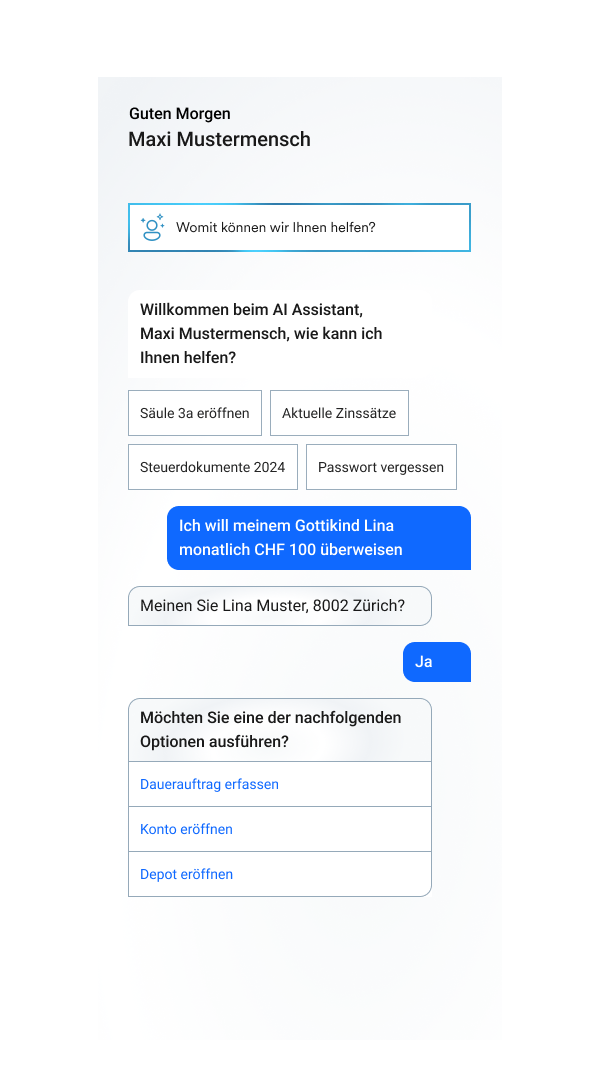
“What is the withdrawal limit on my savings account?”, “Show me all payments to Galaxus in the last six months,” “I would like to set up a new standing order: Transfer 100 francs to my grandson’s savings account every month.” Customers use their mobile or online banking every day for questions and actions like these. Integrating the AI Banking Assistant into ti&m Banking makes things much easier and more customer-friendly. The assistant combines a chat interface with the functions and data of ti&m Banking, controlled by an LLM that the bank is free to choose. End customers interact directly with mobile or e-banking via the AI Banking Assistant and do not have to search through menus or look for functions. They formulate their request in the chat and the assistant provides information, suggests the appropriate action, or explains functions based on bank guidelines, provided documents, and the ti&m Banking modules. Guardrails ensure that the assistant only talks about the topics for which it is authorized and does not process any inadmissible or sensitive information.
Many customers find the wide range of functions offered by modern mobile and ebanking overwhelming and are often only familiar with a fraction of the possibilities. Functions they rarely use, such as adjustments to e-bills, often cause them difficulties. This results in calls and emails to the support team. The AI Banking Assistant helps customers find the functions they are looking for quickly and easily, even if they are unfamiliar or rarely used. By allowing customers to interact using natural language, as they are already accustomed to in other areas, the AI Banking Assistant makes the full range of mobile and e-banking functions more accessible and creates an intuitive banking experience. Without the need for instruction and without any detours or frustration.
Innovative banking that inspires
With Data Fusion and the AI Banking Assistant, we are making our banking products and our customers more fit for the future. Data Fusion allows banks to provide their customers with new modules and applications, while the AI Banking Assistant offers an AI-assisted banking experience that is accessible, intelligent, and consistently user-centric.
ti&m Special “AI & Open Source”
Why AI and open source belong together
Special
Banken müssen ihr E-Banking neu denken
Schweizer Banken müssen ihr E-Banking zu einem vollwertigen Sales- und Marketing-Channel weiterentwickeln, um langfristig gegen die Konkurrenz von Neo-Banken bestehen zu können. Mit dem neuen ti&m E-Banking bekommen sie alle nötigen Werkzeuge an die Hand.
- Jan 31, 2020
Special, AI-and-Open-Source
How open source can strengthen digital sovereignty
Digital sovereignty // It is becoming increasingly vital that businesses, public administrations, and society view technological adaptations in the context of digital sovereignty. With the ti&m Open Source Stack, we are helping companies and institutions maintain sovereign control of their data, processes, and applications in the long term.
Thomas Wüst - Feb 3, 2026
Special, AI
Cyber risk mitigation — increasing costs or creating value?
Cybersecurity // Protecting critical data, systems and processes affects core elements of a company’s value creation chain, and is directly linked to the firm’s success. Company management teams must manage these cyber risks and be proactive in staying aware of the associated responsibilities.
- Mar 20, 2024