



Skip to content
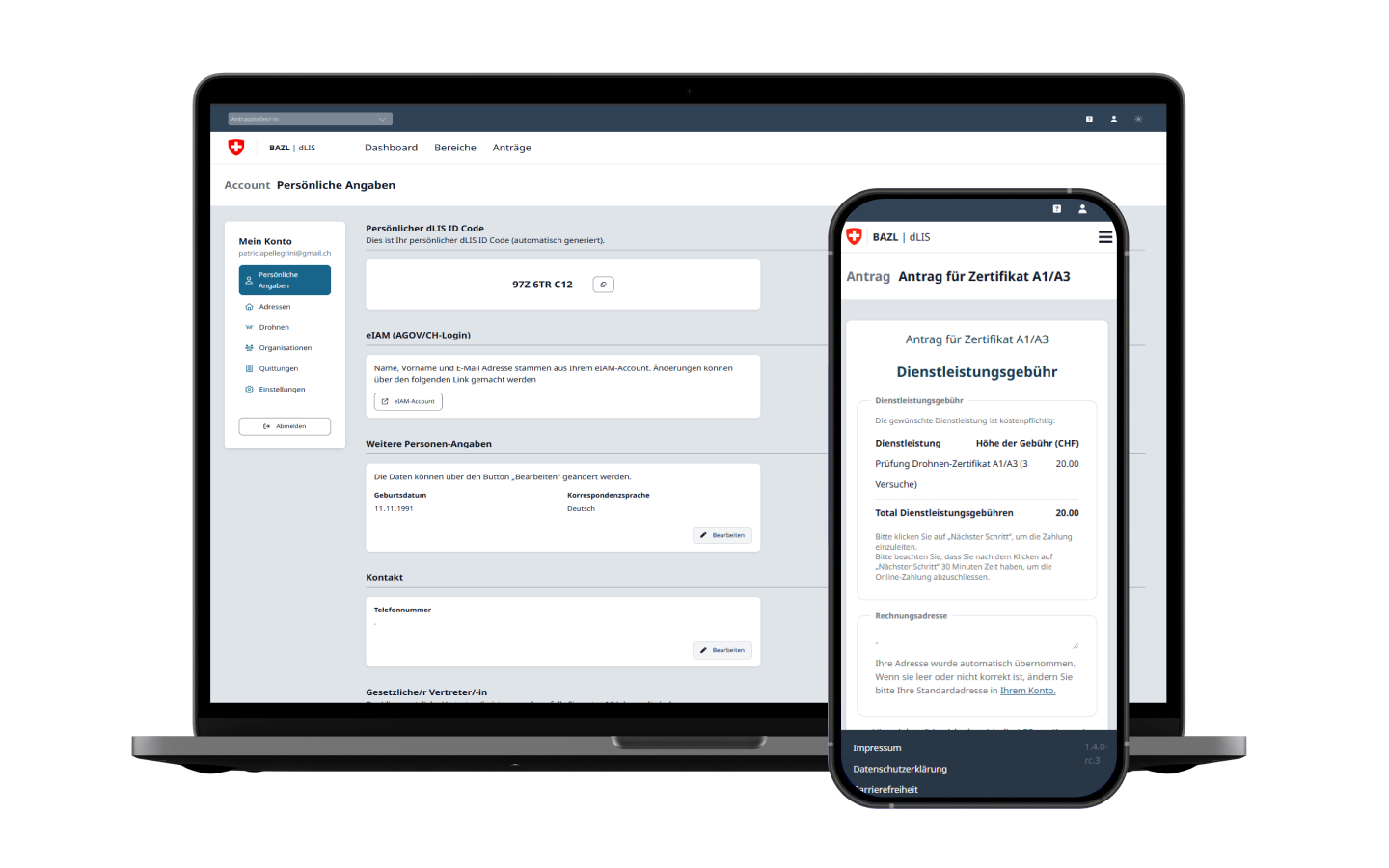
The system replaces the previously paper-based procedures for licenses in aviation, from drones to pilots and ground staff, with a fully digital, user-friendly solution. Today, licensing processes are efficient, transparent, and secure – for the FOCA as well as for tens of thousands of applicants.

From paper forms to end-to-end online processes

Until the introduction of dLIS, pilots and flight schools had to submit their applications by post or scanned by e-mail. Each application had to be checked, recorded and processed manually – a very time-consuming operation requiring huge administrative effort.

The FOCA has fully digitized these processes with the dLIS digital licensing system: From registration, training, and examination to payment and the issue of certificates, every step is carried out without any media discontinuity. The first part went live at the end of 2024 and enabled drone pilots to apply for certificates online. Since then, new functions have been continuously added, such as payment options or the automated booking of appointments for theory examinations. The service has been gradually expanded to include further processes for additional target groups.

+42’000

Registered users

+23’000

Payments

+14'000

Certificates issued

Complexity mastered – with clear architecture and agile implementation

The implementation of dLIS was both professionally and technically challenging, with numerous stakeholder groups such as drone pilots and flight schools having to be taken into account and integrated across eleven peripheral systems. ti&m assumed overall responsibility as the general contractor, delivering project management, architecture, and UX design through to development, integration, and test management. Implementation was carried out in a hybrid project model based on HERMES and Scrum: After a classic concept phase, the development was implemented agilely with three-week sprints. Technologically, dLIS is based on a modern, modular architecture with one backend and two frontend applications, separated into internal and external user groups. A specially developed integration layer acts as a data hub for communication with all peripheral systems. Camunda Platform 8 is used as the workflow engine to control complex approval and checking processes.

Built on proven ti&m technologies

For the implementation, ti&m relied on its own eGov framework and a number of Solution Building Blocks, including those for dynamic forms, workflow integration, and UI & portal based on Next.js. Modern web technologies such as React, TypeScript, Tailwind, and JSON Forms are used in the frontend, while Spring Boot, Camunda, Postgres, and Zeebe ensure stability and scalability in the backend. The solution runs containerized on OpenShift and Kubernetes, which gives it cloud capability and ensures high availability. Thanks to its integration into central systems such as EMPIC-EAP (the International Aviation Licensing System) and SAP, dLIS fits seamlessly into FOCA’s system landscape.

“License management is a high-volume business. Since we started using dLIS, we have been working much more efficiently. In ti&m we have a partner that quickly familiarizes itself with new areas and implements projects with technical and financial transparency.”

– Head of the Flight Personnel Section, Federal Office of Civil Aviation (FOCA)

More efficiency, less effort

A big step into the digital future. dLIS brings measurable benefits to FOCA and its users:

Greater efficiency

Automated processes significantly reduce processing times and administrative effort.

Cost savings

Digital processing reduces process costs and simplifies data management.

User-friendliness

Applicants can complete their licensing process conveniently online – regardless of time and place.

Future-proof

The modular architecture makes it possible to flexibly integrate new license types and regulatory requirements.

Modular, efficient, sovereign – with Solution Building Blocks

With dLIS, the Federal Office of Civil Aviation (FOCA) has consistently digitized its licensing processes and set new standards for modern, citizen-oriented administrative solutions in Switzerland. The digital transformation of public administration requires speed, efficiency, and digital sovereignty. Our Solution Building Blocks provide administrative authorities with precisely these tools: modular, reusable building blocks for backend, frontend, processes, master data, and security, combined with proven architecture and integration patterns as well as methodical templates. Core components of the new system, such as the eGov Framework, dynamic forms, workflow integration, and the UI & portal, are based on these Solution Building Blocks.

Solution Building Blocks accelerate project implementation, improve collaboration between the business and IT sides, and ensure that solutions remain flexible, scalable, and maintainable in the long term. They combine the flexibility of customized software, the stability of standard solutions, and the digital sovereignty of open source. This enables administrations to implement digital services faster, more efficiently, and independently of individual manufacturers – from proof of concept to the full application.

Head of eGov & Industries

Magdalena Koj

Build with us: Smart solutions for digital sovereignty, block by block.